The Airtight Case for Passivhaus
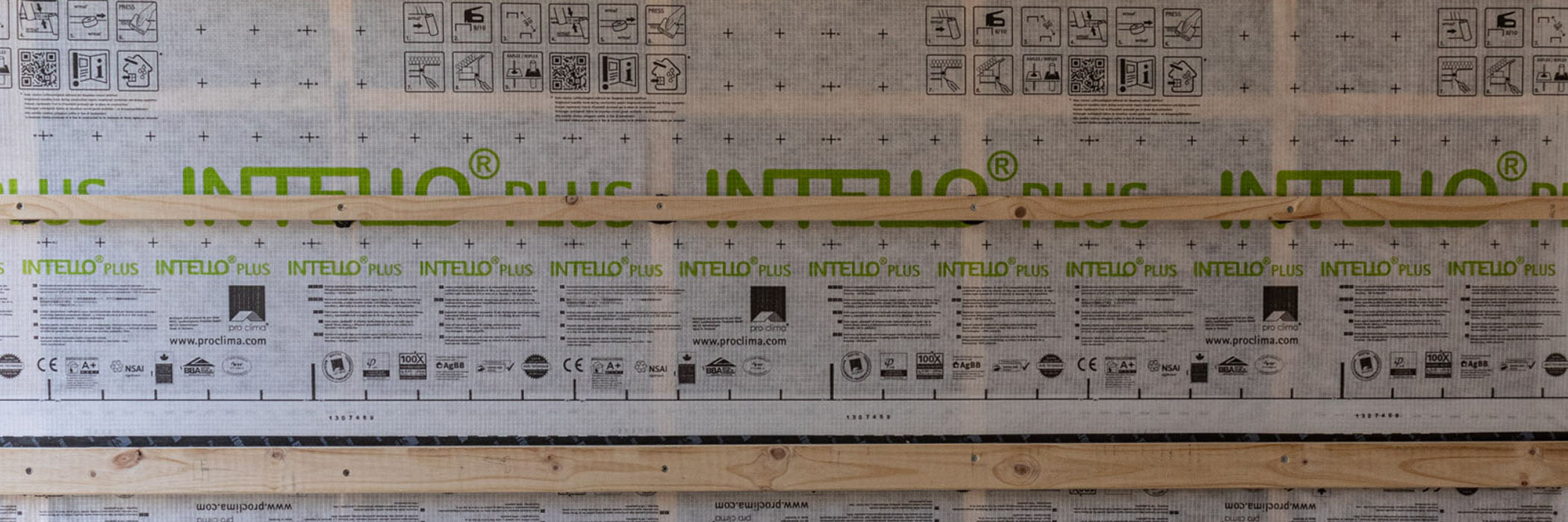
Why control, not sealing, underpins high-performance construction
Airtightness is one of the most misunderstood aspects of high-performance construction.
It is often described as “sealing a house up”, creating concern about stale air, moisture build-up or discomfort. In reality, airtightness is about control. It limits unintended air movement so that ventilation, comfort and durability can be managed deliberately.
From a construction perspective, airtightness is not a theory or a design aspiration. It is a measurable outcome that depends on detailing, sequencing and site discipline.
Airtightness in context
Air moves through buildings whether it is planned or not. When that movement is uncontrolled, it carries heat and moisture with it.
This undermines:
- Thermal performance
- Comfort
- Moisture management
- Predictability of ventilation
Airtightness limits this unintended air leakage. It does not prevent fresh air from entering a home. Instead, it allows fresh air to be introduced intentionally and consistently.
For a grounding in how air movement interacts with heat and moisture, see Building Physics Made Simple.
Why airtightness matters in Australian homes
In Australian construction, air leakage is rarely measured and often assumed to be benign. In practice, it contributes to:
- Heat loss in winter and heat gain in summer
- Drafts and uneven temperatures
- Increased energy demand
- Moisture being driven into wall and roof assemblies
As homes become more insulated, uncontrolled air leakage becomes more problematic rather than less. Airtightness ensures insulation performs as intended.
Airtightness and ventilation
Once unintended air leakage is limited, ventilation can be designed and delivered intentionally.
In high-performance homes, this is typically achieved through mechanical ventilation with heat recovery (MVHR). MVHR systems supply filtered fresh air while extracting stale air, transferring heat between the two air streams.
From a construction perspective, airtightness and ventilation are inseparable. A ventilation system cannot perform predictably in a leaky building.
This relationship underpins the Passivhaus (Passive House) approach to indoor air quality and comfort.
Airtightness as a construction task
Airtightness is not achieved through a single product or trade. It is the cumulative result of hundreds of small decisions on site.
Key factors include:
- Continuity of the airtight layer across all junctions
- Careful detailing around windows, doors and services
- Sequencing that protects membranes from damage
- Coordination between trades to avoid penetrations and rework
Most airtightness failures occur at interfaces rather than in large areas of wall or roof.
Testing and verification
One of the strengths of the Passivhaus framework is that airtightness is verified through testing.
Blower door testing measures air leakage at a standard pressure and provides an objective result. This removes ambiguity and assumptions from the process.
For builders, testing:
- Identifies issues while they are still accessible
- Reduces the risk of hidden defects
- Provides confidence that performance targets have been met
Airtightness that is not tested is simply assumed.
Airtightness and summer performance
Airtightness is often discussed in relation to winter heating demand, but it is equally important in summer.
Uncontrolled air leakage allows hot external air to enter the building during the day and undermines night-time cooling strategies. It also reduces the effectiveness of thermal mass and shading.
The role of airtightness in managing summer comfort is explored further in Designing for Overheating in a Warming Climate.
Airtightness is not a design feature
Airtightness is rarely visible once a home is complete. It does not affect aesthetics or architectural expression.
Its success depends on:
- Clear documentation
- Buildable details
- Construction discipline
- Testing and follow-up
This is why airtightness is fundamentally a delivery issue, not a styling choice.
The importance of early coordination between architects and builders in achieving this is discussed in Client Benefits of Architect–Builder Collaboration in Passivhaus Construction.
Why Passivhaus sets a different benchmark
Passivhaus places a clear, measurable limit on air leakage. This forces airtightness to be addressed systematically rather than incidentally.
More importantly, it treats airtightness as part of a broader system that includes insulation, ventilation and thermal control. This systems approach is what delivers reliable outcomes.
For context on how this performs locally, see Does Passivhaus Work in Australia?
Control enables comfort
Airtightness does not make a home uncomfortable. Poorly executed construction does.
When air movement is controlled, ventilation can be delivered consistently, insulation performs properly and internal conditions become predictable. Comfort improves as a result.
Airtightness enables control. When air movement is deliberate rather than accidental, ventilation becomes predictable, insulation performs as intended and comfort improves as a result.