Circular Construction in Practice: Fitzroy Waste Outcomes
What our Fitzroy project reveals about waste, verification and real recovery
For most residential projects, waste is treated as an afterthought. Bins are ordered late, separation is inconsistent, and success is measured by whether the site looks tidy rather than where materials actually end up.
At our recent Fitzroy Passivhaus project, we took a different approach.
This project became a live test of whether structured planning, disciplined site practices and verified data could move residential construction beyond compliance and toward genuinely circular outcomes.
The result was not marginal improvement, but a step change.
The headline outcomes
Across demolition, excavation and construction, the Fitzroy project generated 282.26 tonnes of material.
Through targeted on-site separation and verified recovery pathways:
- 257.19 tonnes were re-used or collected for recycling
- 91.1% total diversion from landfill (including hazardous waste)
- 97.5% diversion when hazardous materials are excluded
- Only 20 kg per m² of gross floor area was disposed to landfill
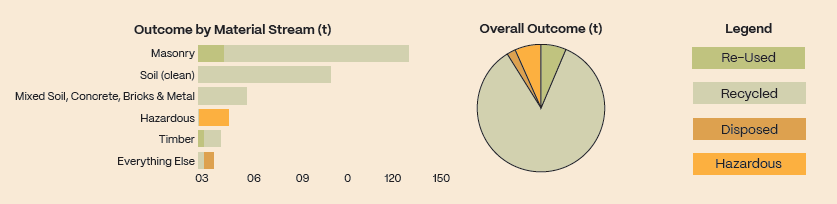
(Above: Verified waste recovery results from HONE’s Fitzroy Passivhaus project, demonstrating high diversion from landfill through source separation and material-specific recovery pathways.)
These figures sit well above typical residential benchmarks and align with the leading edge of what the GBCA identifies as best-practice recovery performance in its Australia’s Wasted Opportunity benchmarking work.
This was not achieved through offsets or assumptions. It was delivered through process, planning and verification on site.
What made the difference
1. Separation at source, not after the fact
Low general waste volumes were one of the strongest signals of success.
Only 4.28 tonnes of general waste were generated across the entire project, with the vast majority of materials directed into dedicated streams:
- Clean soil
- Masonry
- Timber
- Metals
- Plastics
- Cardboard
This level of separation does not happen accidentally. It requires early planning, clear labelling, physical space allocation and consistent site discipline.
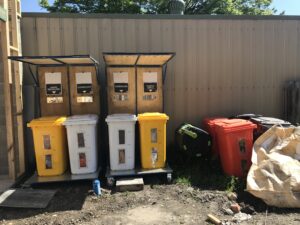
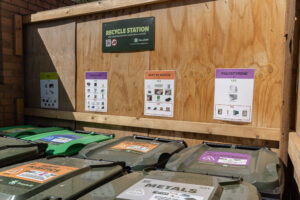
(Above Left (Earlier recycling trial): multiple streams, but higher effort and contamination risk. Above Right (Fitzroy site recycling station with Recycle All): clear labelling, material-specific streams and contractor-managed collection.)
The difference at Fitzroy was not the number of bins, but the system behind them.
With Recycle All, material streams were clearly defined, signage was unambiguous and collections were managed directly from site rather than relying on our team to transport materials to multiple recycling depots.
This reduced handling, reduced contamination risk and made correct separation the default, not an extra task competing with construction delivery.
2. High-value recovery, not just diversion
Headline diversion rates can hide poor outcomes if materials are down-cycled or contaminated.
At Fitzroy:
- 81.7 tonnes of clean soil were recovered
- 114.46 tonnes of masonry were collected for recycling
- 18.28 tonnes of material were directly re-used (bricks and roof tiles) or turned into custom furniture (hardwood timber)
- 238.91 tonnes went through verified recycling pathways
Masonry and soil alone accounted for the majority of material mass. Getting these streams right had an outsized impact on outcomes.
This aligns directly with national data showing that excavation and demolition materials dominate residential waste profiles, yet are often poorly managed.
A note on plastics and why weight alone is misleading
One limitation of weight-based reporting is that it systematically understates the impact of plastics.
Plastics represent a small fraction of total tonnage but occupy a disproportionate volume on site and in landfill. Left unmanaged, they quickly dominate general waste bins, drive contamination and undermine recovery rates for heavier materials.
On most residential sites, plastics determine whether recovery systems succeed or fail, despite barely registering in weight-based reporting.
Separating soft plastics, rigid plastics and polystyrene reduces bin churn, preserves higher-value masonry and timber streams and removes a common failure point seen on residential sites.
Measuring by weight tells only part of the story, controlling plastics is often what makes high recovery rates achievable in practice.
3. Hazardous waste handled deliberately
Hazardous materials (asbestos and contaminated soil) accounted for 18.58 tonnes of the total waste stream.
Rather than diluting this into mixed loads, hazardous waste was:
- Identified early
- Isolated on site
- Tracked and disposed through compliant pathways
This prevented contamination of otherwise recoverable materials and reduced compliance risk.
Excluding hazardous waste, the project’s landfill fraction dropped to just 2.5% — an outcome rarely measured, let alone achieved, in residential construction.
How this compares to industry norms
According to the Green Building Council of Australia’s 2025 benchmarking, construction waste performance typically:
- Relies on high-level diversion figures rather than verified, material-level reporting
- Shows wide variability in recovery outcomes across projects and sectors
- Depends heavily on contractor estimates and aggregated dockets, limiting confidence in reported results
Fitzroy demonstrates that these limits are not technical, they are process-driven.
With clear planning, the right contractor partnerships and transparent reporting, residential projects can perform at levels normally associated with large commercial developments.
The role of contractors and systems
Recovery performance depends on who you work with and how clearly expectations are set.
For this project, we partnered with specialist waste contractors including:
- RecycleAll, providing structured on-site separation systems and material-specific recovery pathways
- JumboCorp, supporting compliant handling of mixed and bulk streams
Just as importantly, data was captured and consolidated into a single, auditable performance summary rather than fragmented dockets and invoices.
Lessons for future projects
The Fitzroy data highlights both strengths and opportunities:
What worked
- Extremely low general waste volumes
- High recovery of masonry and soil
- Clear hazardous waste isolation
- Verifiable, material-level reporting
What can improve
- Further reduction of existing plaster and composite disposal
- Focus on reduction in total waste generation
- Expanded re-use pathways for materials
Circularity is not a fixed outcome. It is an iterative process.
Why this matters
Waste performance is often discussed in abstract terms — percentages, policies, targets.
What Fitzroy demonstrates is that circular construction is delivered on site, not in strategy documents.
When waste is planned with the same rigour as structure, airtightness or thermal performance, the results are measurable, repeatable and defensible.
This project moves waste from a compliance obligation to a verified performance outcome and sets a benchmark for what residential construction can achieve when circularity is treated as a core system, not an add-on.